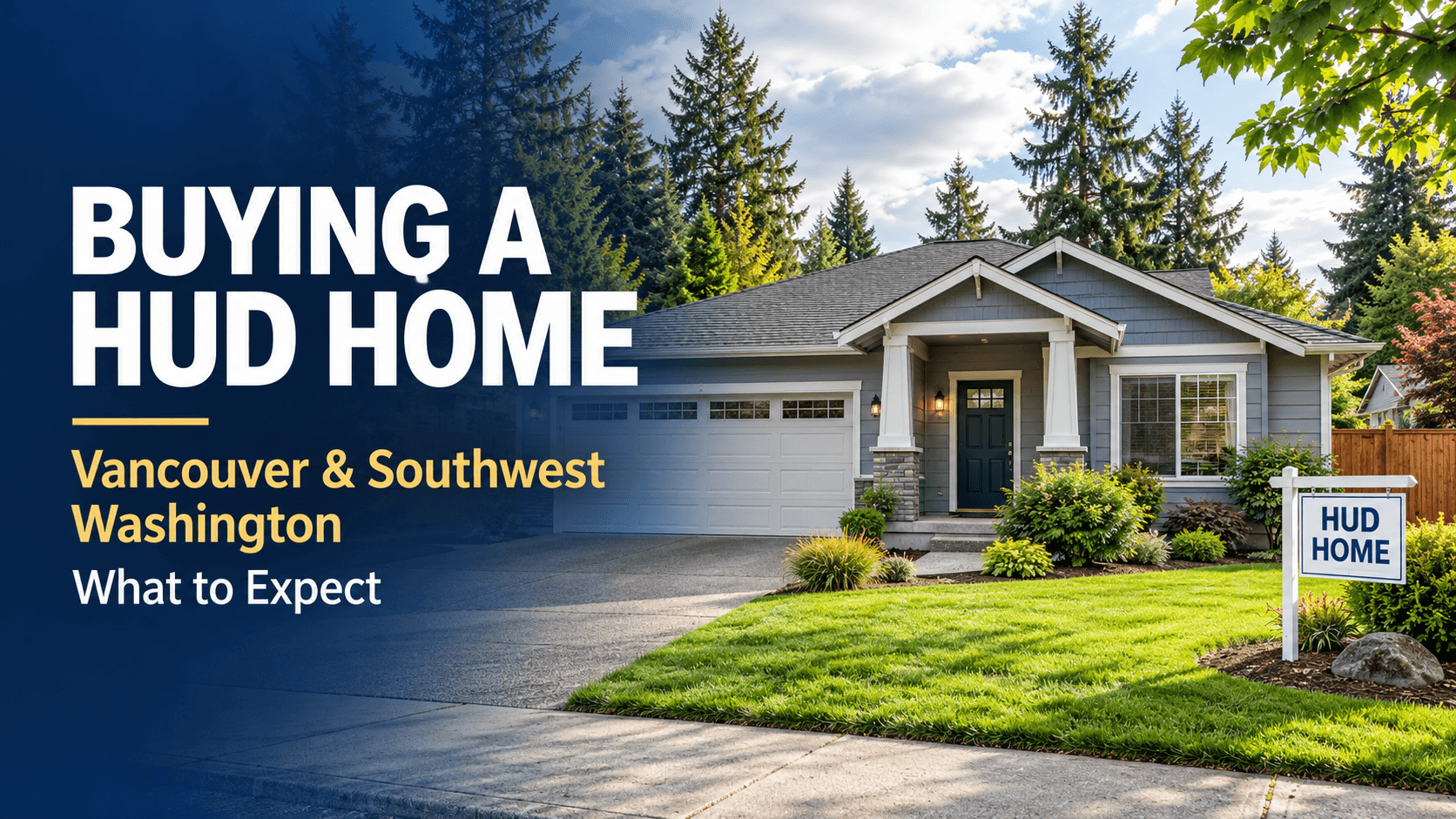
Buying a HUD Home in Vancouver and Southwest Washington: What to Expect
HUD homes in Clark and Cowlitz Counties don't come up often. This guide covers FHA eligibility codes, utility turn-on rules, the stove issue, and the $100 down option for eligible owner-occupants.
By Bill Black, Senior Mortgage Broker and Certified Mortgage Planner with Northwest Funding Group Inc, CEO at NW Bild LLC, CEO of Black Investment Group and lead at Team Black.
A HUD home is a house that was foreclosed with an FHA loan and is now owned by the U.S. Department of Housing and Urban Development. HUD sells these homes to recover what it paid on the mortgage claim.
For buyers in Vancouver, Battle Ground, Camas, Ridgefield, Washougal, Longview, and Kelso, HUD homes can be a real opportunity: eligible buyers may be able to purchase with $100 down and ask HUD to help with closing costs. They also come with rules that surprise buyers who expect a normal sale.
One honest note up front: Clark and Cowlitz Counties usually have only a handful of HUD listings at any given time. When a good one appears, the buyers who already know the process are the ones who get it. Here’s that process.
How HUD homes are sold
HUD homes are listed through HUD’s own bidding system, not like a typical seller listing. A few things work differently.
You need a HUD-registered broker. Offers are submitted online through HUD’s system, and only a real estate broker registered with HUD can submit a bid for you. You can reach out to Kelyn Black owner of Selling Keys Real Estate for more information- she is very experienced in this market.
The listing agent works for HUD. There’s no homeowner to negotiate with. HUD’s contract package and addenda control the deal, and the deadlines in them are strict. Missing one can cost you the house or your earnest money.
Owner-occupants get first priority. HUD gives buyers who plan to live in the home an exclusive bidding window before investors can bid. If you’re buying a home to live in, that window is your advantage. Owner-occupant buyers sign a certification that they’ll live in the home, and HUD takes that certification seriously.
Check the FHA eligibility code first
Every HUD listing carries a code that tells you how it can be financed. This is the first thing to check, before you schedule a showing.
IN (insurable): The home qualifies for a standard FHA loan.
IE (insurable with escrow): The home qualifies for FHA, and the loan can include a repair escrow so certain repairs are completed after closing.
UI (uninsurable): The home does not qualify for a standard FHA loan. Buyers typically use cash, conventional financing, or a renovation loan like the FHA 203(k), which rolls the purchase and the repairs into one mortgage.
The code also decides whether the $100 down option is available, so knowing it early saves time for everyone.
What “as-is” really means
HUD sells homes as-is. HUD doesn’t make repairs and doesn’t negotiate repairs after inspection. The price usually reflects the condition, but you still need an inspection. Get contractor pricing before you remove contingencies so you know your true cost of ownership.
As-is doesn’t mean you skip the appraisal. Your lender still orders one, and the appraiser still has to confirm the home meets the minimum standards for your loan type. That’s where utilities and appliances come in.
When the utilities are off
Many HUD homes sit vacant with the water and power off, and some are winterized. An appraiser can’t test plumbing, electrical, heating, or appliances without utilities on. If the appraisal is done with utilities off, expect conditions and a return trip once everything is on and tested, which typically cost an additonal $150 to $250 dollars. You really wouldn't want to buy a house not knowing if the toilets flush or there's no power.
Start with the Property Condition Report. The key question is why the water is off. If the plumbing failed a pressure test or has known damage, activation may be denied. Find that out before you schedule the water company, a contractor, and the appraiser for the same day.
If the home is under contract but hasn’t closed, the buyer’s agent needs written approval from HUD’s Field Service Manager (FSM) before anyone turns the water on. Nobody should just call the water company.
The usual process:
- Get the FSM contact and utility activation form from the listing agent or HUD contract package.
- Submit the request with the HUD case number, property address, and proposed turn-on and turn-off dates. The contract must be fully executed first.
- If the home is winterized, follow the FSM’s instructions and have an approved contractor de-winterize it before the water goes on.
- After written approval, coordinate the water company, contractor, and inspector or appraiser. The buyer generally pays activation charges, deposits, and de-winterization and re-winterization costs.
- Complete testing within the approved window, then shut the water off and re-winterize as required. Some windows are as short as 72 hours, excluding weekends and federal holidays, so confirm the property’s specific instructions.
- Build extra days into your closing timeline. The appraisal, the utility window, and the re-inspection rarely line up on the first try.
The stove question
This detail stalls files when nobody catches it early.
FHA generally doesn’t require a stove, so a missing range by itself usually won’t stop an FHA loan. Conventional and VA loans are different. Many appraisers and lenders will condition those loans on a working range in the kitchen. If you’re not using FHA, plan to solve this before the final inspection:
- Install an inexpensive range and have the appraiser verify it on the re-inspection.
- Ask your lender whether an escrow holdback for the appliance is allowed on your loan.
- Confirm the exact requirement with your lender, since requirements vary by lender.
Don’t expect HUD to install a stove. The home is sold as-is, and this is much cheaper to solve early than the week of closing.
The $100 down option and closing cost help
HUD offers a $100 down payment option on FHA-eligible HUD homes for qualified owner-occupant buyers. Instead of the standard FHA down payment, you put down $100, and the rest of the loan works like a normal FHA loan.
On top of that, buyers can ask HUD to pay part of their closing costs as part of the offer, commonly up to 3% of the purchase price. HUD weighs that request against the net it receives, so it affects how competitive your bid is, but it’s worth discussing with your agent and lender before you write the offer.
Together, these two features can bring the cash needed to buy a home down to a fraction of what a typical purchase requires.
Want to know if you qualify for $100 down, or whether a specific HUD home is FHA-eligible? Reach out to the lending team at bill@billcblack.com or text/call 360-910-3290 or the Real Estate Team kelyn@sellingkeys.com or 503-707-7011, and we’ll check the property and your numbers before you write an offer.
For investors
Investors can bid on HUD homes once the owner-occupant window closes. Homes that sit, especially UI-coded properties that need work, can be good candidates for cash purchases, renovation loans, or investor financing based on the property’s rental income. The as-is rules and utility process apply to you too, so price in the repairs and the extra days.
Two common misconceptions
HUD homes are only for low-income buyers. Not true. HUD runs assistance programs for low-income families, but HUD homes are different. They’re foreclosed FHA homes available to any qualified buyer, often at competitive prices.
HUD homes are always rundown. Not true. HUD homes vary in location, size, and condition like any other listing. Some need work. Some are move-in ready. The price reflects the condition, and an inspection is still the right move.
What to expect at closing
- A longer, more paperwork-heavy contract than a typical sale
- Strict deadlines in the HUD addenda
- An as-is home with no seller repairs
- Possible utility coordination, a re-inspection, and extra days on the calendar
- Standard FHA closing costs and prepaid items, reduced by any closing cost help HUD agrees to
Frequently asked questions
Do I need a special agent to buy a HUD home?
Yes. Offers must be submitted by a real estate broker registered with HUD.
Can I buy a HUD home with a VA or conventional loan?
Yes, but the $100 down option is for FHA only, and conventional and VA loans may require items like a working stove before closing.
Can investors buy HUD homes?
Yes, after the owner-occupant priority window ends.
Can I buy a HUD home that needs major repairs?
Often, yes. A renovation loan like the FHA 203(k) can finance the purchase and repairs together, depending on the property’s eligibility code.
Bottom line
A HUD home can be a smart buy in Clark or Cowlitz County if you go in with your eyes open. Check the eligibility code, read the Property Condition Report, get FSM approval before anyone touches the utilities, solve the stove question early, and ask about $100 down and closing cost help before you write the offer. Do those things and you avoid the delays that catch most HUD buyers off guard.
HUD listings in Clark and Cowlitz Counties don’t come up often, and the owner-occupant window is short. Hunter Dixon, our buyer’s agent at Selling Keys Real Estate, can set up alerts so you see new HUD listings the day they post. He handles the bid, the FSM utility request, and the coordination with your lender, so the process stays on schedule. Buying outside Southwest Washington? We can connect you with a trusted agent in your area. Visit www.sellingkeys.com or call 503-707-7011 to get started.
About the author: Bill Black is a Senior Mortgage Broker and Certified Mortgage Planner with 20+ years of experience and 1,500+ closings in Southwest Washington. He and his wife Kelyn, owner and Principal Managing Broker of Selling Keys Realty, lead Team Black, an integrated mortgage and real estate team serving Clark and Cowlitz Counties.
Bill Black, NMLS #49242 | Northwest Funding Group Inc., NMLS #101770 | Licensed in WA, OR, and AZ | Equal Housing Opportunity. Real estate services provided by Selling Keys Realty. Educational information only, not a loan offer or guarantee of financing. Loan requirements vary by program and lender.